

Veterinary Care for the Wolves of Wolf Hollow
Caring for wolves takes time, patience, and understanding.

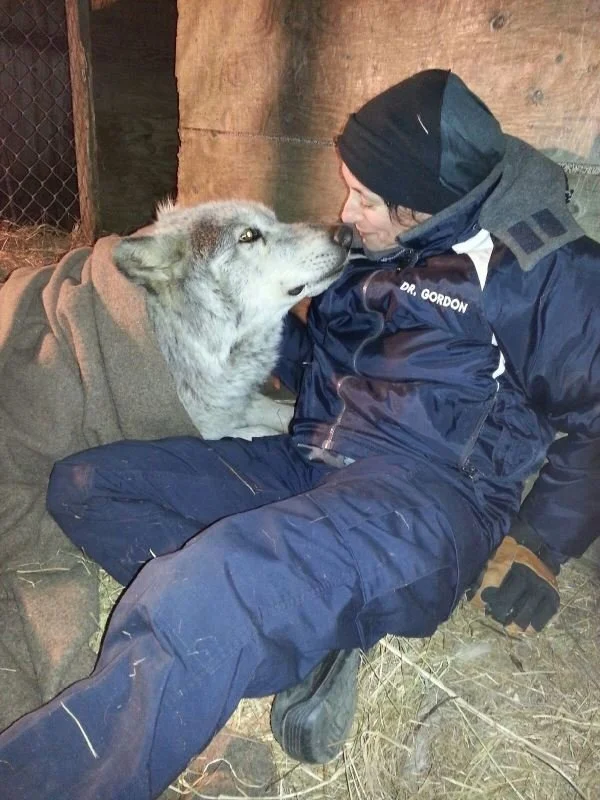
The wolves at Wolf Hollow are socialized, but not domesticated. This means that we raise them in such a way so that they allow us to interact with them, but they maintain their wild nature and instincts.
With time, patience and care, mutual trust is developed and nurtured throughout their lives.
-
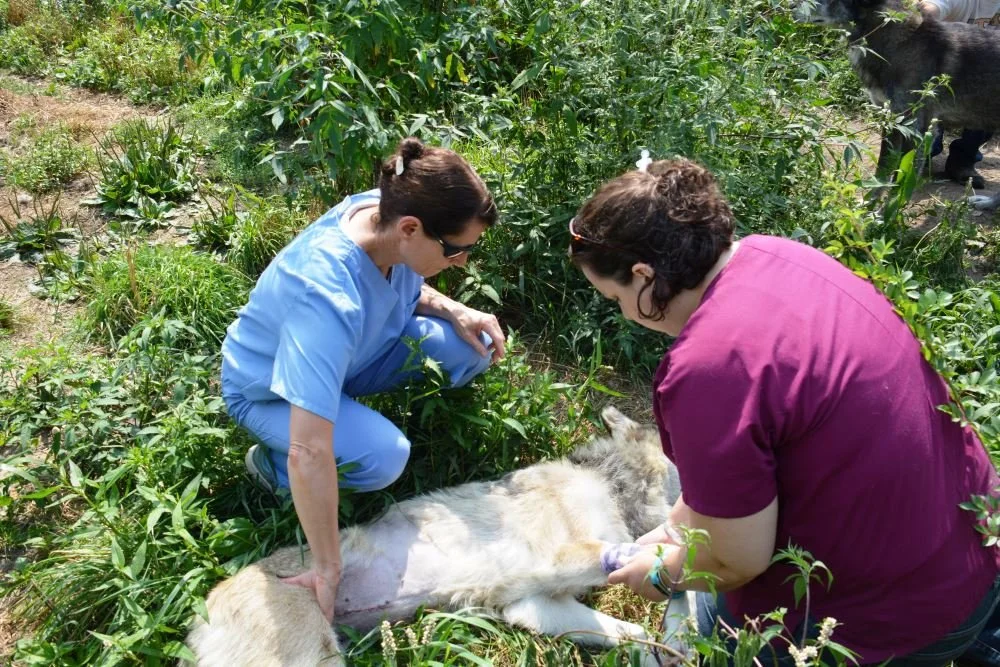
Wolves are closely related to domesticated dogs. Their veterinary care is very similar as well. Wolf pups receive a series of "puppy" vaccines, and then are vaccinated as per guidelines developed by the American Animal Hospital Association. Rabies vaccination is the only one required by law, dictated by the State of Massachusetts. Because we have socialized the wolves, these vaccinations can be given without sedation.
-
Preventative medicine is also a part of their health care. Every month the wolves receive protection against heartworm, parasites, fleas, and ticks. This may be in the form of a skin application product or a tablet. Fecal tests are performed twice a year, and additional medicine given as needed for parasites not covered by their monthly pills. The hardest insect we have trouble controlling is black flies. DEET products are toxic, and other lotions are difficult to get onto their ears. We will spray Skin-so-Soft on the grass and they will roll in the scent pool. This works fairly well, but does need reapplication daily.
-
Wolf health is monitored constantly, by everyone. Abbreviated examination is performed every time I (Dr. Gordon) am with the wolves, 2-3 times a month. This includes observation and palpation while giving scratches and belly rubs. Volunteers get to know the wolves, and can tell when something is not right. Any of them may observe a wound or lameness, coughing or diarrhea, lack of appetite, weight change, or other abnormality. I ask them to take photos, video, and monitor until I can check them.
-
Food and fresh water play a role in wolf care as well. Proper nutrition is vital to maintain strength and health. A meat log formulated for captive carnivores, complete with nutrients, vitamins and minerals, is fed to each wolf every 2-3 days. Additional treats for presentations include fish, seared meats, and watermelons in the summer and pumpkins in the fall. They are offered sweet potatoes to put on weight, and carrots to lose a little weight. They absolutely adore cheese, so much so that fights break out, so we cannot give them that anymore.
Fishermen sometimes drop off tuna or other fish. Animal control and other agencies will bring deer that have been killed on the road, and they get an occasional beaver the Forestry Service may bring. These provide a more natural diet and give the wolves bones and marrow to gnaw on. We do not provide live prey for them to hunt, as this is considered inhumane and even if it were not against the law it is not a practice we would use. Occasionally a farmer will bring a farm animal that has died. We so appreciate the offer, but without knowing the cause of death we do not take a chance giving the wolves a food source that may be unhealthy.
The pond in the main enclosure provides clean water when it is full (it has been tested). All the wolves have at least 2 buckets that are cleaned and filled at least daily with fresh clean water. Snow is another source of hydration, although they seem to play with it more than eat it!
-
Another aspect of health is providing shelter. Each enclosure has a wooden structure to provide shade and protection from the wind. Often the wolves will dig beneath these structures, or dig a den on their own. Trees and bushes provide cool dirt and shade in the summer, protection in the winter. More often than not the wolves in the main enclosure enjoy sunning themselves on the frozen pond. When it snows, hay and shavings are placed in the wooden structures, as well as in spots where they like to curl up and nap.
-
Environmental and emotional stimulation plays a very important role in the health of the wolves. Stress can have a deleterious effect on their well-being. Weekend presentations, photo sessions, group presentations during the week, and their daily care all provide some level of stimulation. Their hunting instincts are intact, so we often find remains of frogs, mice, snakes, and other creatures that inadvertently get into the enclosures. They tend not to eat these unfortunate visitors to the facility, but do like to carry them around.
Any wolf that has been separated due to concerns for their safety is closely monitored for signs of stress. Jelly, up until the time she passed peacefully in her sleep, lived alone and preferred it that way. She bullied every wolf placed with her, and was definitely queen of her territory. Osa did not do well alone, and she was given Bear, our only wolf-dog hybrid, to raise, and they lived happily as a pack of two. Linnea was separated when she was younger and did very well for about a year, then began showing signs of stress, and so was reunited with a sibling. Now, in her older years, she’s loving the single life.
-
Occasionally a volunteer will notice something that needs attention. Most often it is a minor wound, a runny eye, a limping gait or a spot of blood on the ground. If the problem can be reasonably assessed by observation, a decision is made whether to treat or not, and we continue monitoring the situation. Minor wounds are often left to heal on their own, but depending on where it is, the depth, and presence or absence of a discharge, antibiotics may be dispensed (given in a yummy treat of course!).
Some situations are more serious, or a minor problem does not improve or progresses. Depending on the situation (illness versus injury), the wolf will be sedated and tests be performed. The sedation substance used is fully reversed so the wolf can recover quickly and be on their feet within a few minutes.
For lengthy testing and evaluation full anesthesia is used. They are intubated (breathing tube), an intravenous catheter is placed, and their heart, lungs, ECG, oxygen, carbon dioxide, blood pressure, temperature, and pulse are monitored throughout the procedure. They receive IV fluids, and any other drug needed to maintain their well-being, including pain control drugs. A complete physical examination, blood draw, urine sampling, radiographs, ultrasound, even surgery if indicated can be performed under the anesthesia. They also get their ears checked, and we get to pull off any burrs and give them a rare brushing. No nail trimming, though!
-
So far, we have chosen to perform all of our wolf surgeries at Wolf Hollow.
A room is cleaned and prepared to receive the sedated wolf, and then all the above mentioned procedures for full anesthesia are performed. Should a wolf require a more advanced procedure, then we will arrange for transport to a veterinary facility.
Some of the more challenging aspects of performing surgery on a wolf have to do with the post-operative care. The medicines are easy to give. Their incisions however cannot have any sutures on the outside for them to lick or chew. Insects are another worry, as well as infection. Despite all these concerns we have had only one incision open, and the surgical wound healed on its own without any long term side effects.
To date, surgeries performed include spay, neuter, wound closure, abscess, and tumors removed from the jaw, limb, toe, and a mammary gland. All masses were assessed as benign and completely removed. When Linnea was anesthetized for a large wound we found several other wounds that were enough of a concern that she was moved to another enclosure.