

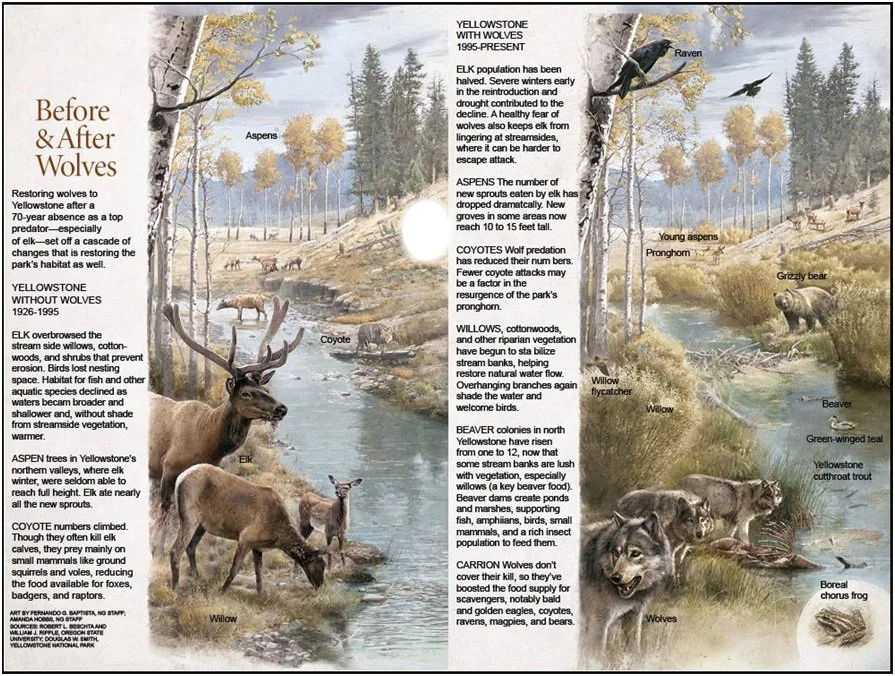
Why we need wolves in the wild:
Reason #1: Without wolves and other large predators, ecosystems can go haywire. A 2001 study [1] found that when wolves went extinct in Yellowstone, for example, the moose population ballooned to five times its normal size and demolished woody vegetation where birds nested. As a result, several bird species were eliminated in the park.
Reason #2: Scavengers thrive when wolves are around. The species that help themselves to wolves' leftovers include [2] ravens, magpies, wolverines, bald eagles, golden eagles, three weasel species, mink, lynx, cougar, grizzly bear, chickadees, masked shrew, great gray owl, and more than 445 species of beetle.
Reason #3: Deer and elk congregate in smaller groups [3] when wolves are around. This helps reduce the transmission of illnesses like Chronic Wasting Disease.
Reason #4: Elk are less likely to overgraze near rivers and streams—damaging fragile ecosystems—when wolves are in the neighborhood.
Reason #5: Wolves help protect against climate change. A 2005 UC Berkeley study [4] in Yellowstone concluded that milder winters, a product of climate change, have led to fewer elk deaths. This left scavengers like coyotes and ravens scrambling for food, but the problem was far less pervasive in areas where wolves were around to hunt elk.
Reason #6: Wolf kills are also good for the soil. A 2009 study [5] in Michigan's Isle Royale National Park found that wolf-killed elk carcasses dramatically enhanced levels of nitrogen and other nutrients.
Reason #7: Wolves keep other predators in check. When wolves disappeared from Yellowstone, coyotes preyed on pronghorn almost to the point of no return. But since wolves have returned, the pronghorn have come back. In fact, pronghorns tend to give birth near wolf dens, since coyotes steer clear of those areas.
Wolves are the largest member of the dog family (canidae). The Adaptable gray wolf (canis lupis) was once found all the way across the Northern Hemisphere. When humans began to establish sedentary, agrarian societies wolves became the enemy of our domesticated flock and a source of fear for the nomadic traveler, and have since been demonized in history and literature throughout the ages.
Sources:
https://animals.nationalgeographic.com/animals/mammals/wolf/
https://canislupus101.blogspot.com/p/reasons-why-we-need-wolves.html
[1] A MAMMALIAN PREDATOR-PREY IMBALANCE: GRIZZLY BEAR AND WOLF EXTINCTION AFFECT AVIAN NEOTROPICAL MIGRANTS J.Berger et.al. Ecological Issues in Conservation. Aug.2001
[2] Predator-Prey Management in the National Park Context: Lessons from a Transboundary Wolf, Elk, Moose and Caribou System. M. Hebblewhite. University of Montana, College of Forestry and Conservation.
[3] Responses of elk herd size to fine-scale spatial and temporal variation in the risk of predation by wolves. S. Creel & J.A. Winnie, jr. Animal Behavior, March 2005.69, p.1181-1189
[4] Gray Wolves as Climate Change Buffers in Yellowstone. C.C. Wilmers & W.M. Getz. March 2005. DOI: 10.1371/journal.pbio.0030092
[5] Wolves modulate soil nutrient heterogeneity and foliar nitrogen by configuring the distribution of ungulate carcasses. JK.Bump et.al. Ecology. 2009 Nov; 90(11):3159-67